
 on September 30, 2026, 12:43 am
Flooding the Zone
by Joyce Vance - Sep 29
Jack Smith kicked off his testimony on the Hill today like this: “I stand by my decisions as special counsel, including my decision to bring charges against President Trump.” He told senators that his investigations developed “proof beyond a reasonable doubt that President Trump engaged in serious crimes against our nation.” He said, “I will not be silenced by continued threats of prosecution from the president or others.”
Then, as Alabama Senator Katie Britt looked on with dawning horror, Missouri Senator (and former prosecutor who apparently never learned the lesson that you don’t ask a question you don’t know the answer to) Eric Schmitt made a fool of himself while attempting to set a perjury trap for Smith.

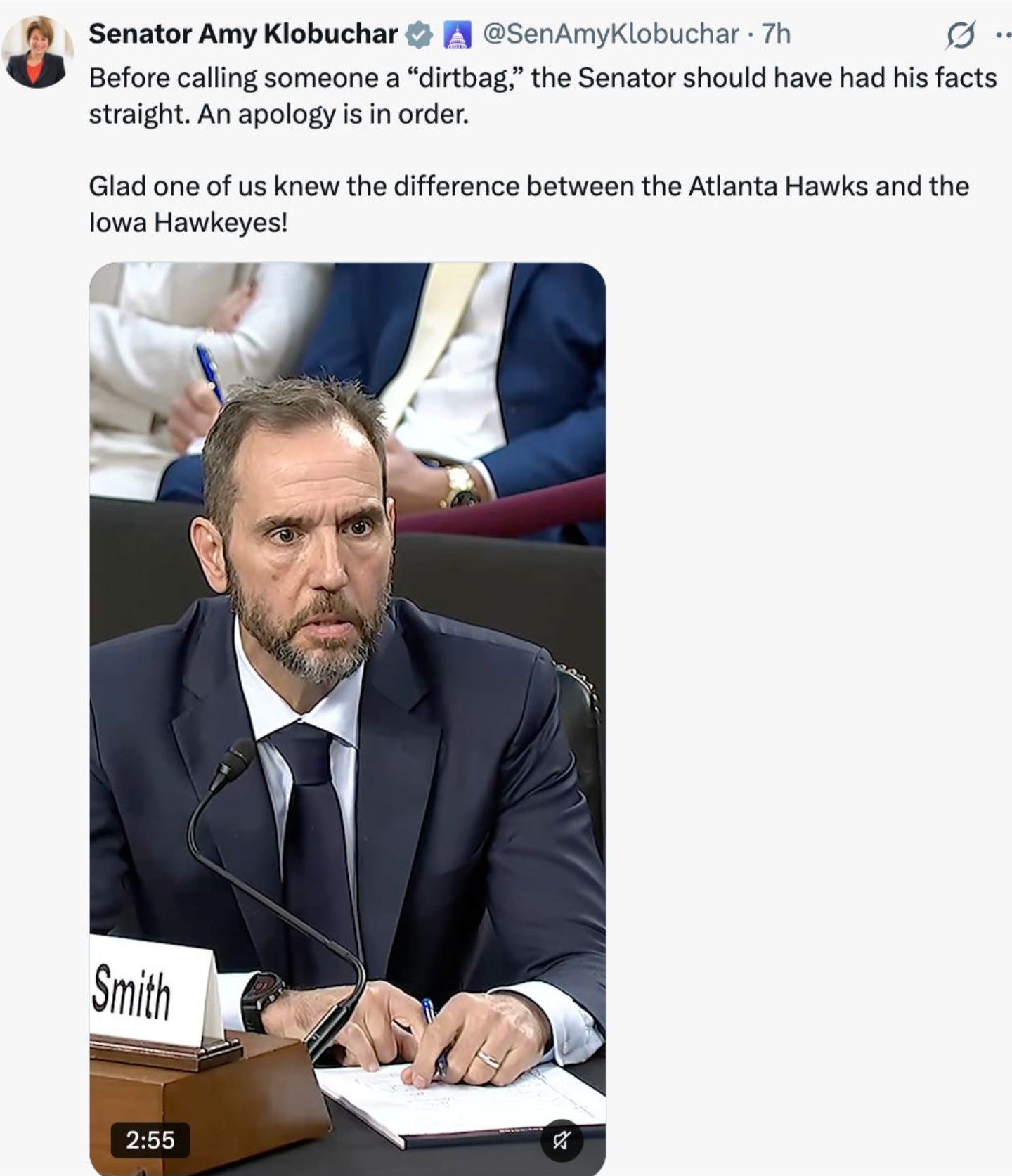
Schmitt thought, based on texts from Smith’s team that he’d acquired, that Smith was in Atlanta watching a Hawks game the day after Fani Willis’ affair with her co-counsel came to light, setting off alarms the Trump camp used to cast doubt on her prosecution of him. Schmitt made the inferential leap that if Smith was in Atlanta, it must have been to meet with Willis; it must have been part of the grand conspiracy the Republicans are still searching for evidence of.
But it turned out that Smith had been to the game between the Maryland Terrapins and the Iowa Hawkeyes to see Caitlin Clark play. Amy Klobuchar used Minnesota nice to wind Schmitt up and he doubled down on his claims long after it was clear to everyone else in the room that he was wrong. Schmitt was left looking like a clown, telling Smith he thought he’d committed perjury when he denied being at a Hawks game in Atlanta. And best of all, he was smirking like he thought he’d scored. That’s the best that they’ve got.
And the government filed its response in the Kennedy Center Case. Arguing that the plaintiff, a member of the board at the Kennedy Center, lacks standing and that putting Trump’s name on the Kennedy Center doesn’t violate the law that clearly prohibits it, the government asked the court of appeals to let it rename the Kennedy Center, making a truly embarrassing argument, even for this Justice Department.
The justification for putting Trump’s name on the Kennedy Center? Trump’s lawyers at DOJ say it’s financial issues and the Center’s state of disrepair. Given that the Center’s financial issues stem from Trump’s efforts to impose his name on it and that a whistleblower reports building safety concerns are a result of the administration's failure to make repairs with funds appropriated by Congress, the government’s position borders on frivolous. “Plaintiffs alleged harms,” the government writes, “pale in comparison to the real harms on the other side of the ledger. For one, the absence of a recognition to President Trump threatens to impede the Center’s fundraising efforts and contribute to the financial decline of the Center.” Pretty sure that’s not the case. Not even close. That one will be hard to maintain in court with a straight face. The brief goes on to recite “the President has been a central force in the Center’s current fundraising efforts, but his supporters will be deterred from contributing to the Center if his name is removed.”
Maybe the administration can find a national security justification for putting Trump’s name on the Kennedy Center. But until then, they’re just intent on violating the law and dishonoring a slain president.
Overnight, lawyers for CNN, MSNOW, and Politico filed an expected motion, asking the court to enter a preliminary injunction guaranteeing them the same access they had at the White House before Trump announced his ban. If the court grants the request, it would go into effect once the temporary 14-day injunction the court granted last week expires.
The plaintiffs explain why it’s essential that their ability to access the White House not lapse: “The losses Plaintiffs will suffer cannot be repaired after the fact. A press briefing Plaintiffs cannot attend is a briefing at which they cannot ask a question; an event they cannot cover is an event they cannot report to their audiences … And each day the ban remains in effect, the public loses access to essential reporting on the President and his administration.” They reiterate the Fifth Amendment Due Process and First Amendment claims they raised when Judge Kelly granted the Temporary Restraining Order.
This is not a difficult case. Trump violated the First Amendment and acknowledged he was doing just that when he posted he didn’t like the plaintiffs’ reporting about him. Three days after banning them, Trump and his lawyers began to wave the national security flag, raising the argument that got them across the finish line in the ballroom case and that they subsequently argued, months after the fact, justified Trump’s plans to build a triumphal arch celebrating himself in Washington, D.C. “The letters that Defendants sent after they banned Plaintiffs and litigation commenced— mere hours before they filed their response to Plaintiffs’ motion for a temporary restraining order—do not cure the violation. The ‘root requirement’ of due process is an ‘opportunity for a hearing before [one] is deprived’ of liberty or property,” they wrote in their brief. But just calling something a national security concern when it really boils down to “I don’t like what those reporters are saying about me” isn’t sufficient to make this the kind of extraordinary situation where First Amendment rights must bend. “The Court has correctly seen these after-the-fact justifications for what they are. ‘The sorts of stories Defendants identify’ as purported national-security risks are ‘routine’—and protected by the First Amendment.” It’s very likely we’ll see a preliminary injunction entered before the TRO expires.
All as the DC Court held en banc argument in In re: Donald Trump. It did not go well for the government. You can listen to the oral argument here, and I encourage you to. The issue was whether Judge James Boasberg has the legal authority to continue with contempt proceedings against Trump administration officials, who, evidence suggests, flouted an order the Judge issued to terminate deportations that occurred without due process.
Multiple judges grilled Brett Shumate, the Assistant Attorney General in charge of the Civil Division, trying to get the government to take a firm position. Shumate seemed to think the Judge had to turn any investigation over to prosecutors. But the Judges focused on Boasberg’s right to conduct an investigation designed to identify people involved so he could refer the case to DOJ. “Why isn’t that what Judge Boasberg’s doing?” one of the panel judges pushed, accusing the Justice Department of ignoring evidence that a government official talked about having to say “F U” to the courts. “You ignored that,” the Judge said, referring to the government’s arguments.
Shumate maintained that the Judge was trying to assume the role of the prosecutor, but Judges pointed out that the issue here was whether they should issue a writ of mandamus to Judge Boasberg, ordering him to stop his contempt investigation. Courts can only issue a writ of mandamus, as DOJ’s own website explains, when the party asking for it can prove they have a clear legal right to the performance of a strict, non-discretionary official duty, and can show that no other adequate legal remedy exists.
The most vocal judges—it’s always difficult to get a sense of where the majority is in an en banc with no video—seemed to believe Judge Boasberg had a right to investigate who was involved in violating his order so he could make a contempt prosecution referral, and that he shouldn’t have to take DOJ’s word for it. If that position holds, there’s no rationale for ordering Judge Boasberg to stand down.
The government’s position, if the court adopted it, would prohibit judges from playing a meaningful role in contempt proceedings and essentially permit the Justice Department, when it’s the party under investigation for contempt, to investigate itself. That’s a nonsensical result, and although two of the panel judges ruled in the government’s favor when the case was first before them, the government may get an entirely different reception with the full court considering the matter. “This is all about word play,” one judge injected as the government continued to insist only prosecutors could investigate. They then pointed out that part of the concern here involves the government stonewalling, only providing Judge Boasberg with “cursory” declarations from the government about what happened after the Judge issued his order, but planes full of migrants continued to fly for El Salvador, leaving them to be herded into that prison. The government, one judge commented, wanted to tie Judge Boasberg’s hands from determining whether contempt occurred and, if so, who should be referred for prosecution. The government never really denied it.
It was another day where we were flooded with drama, all of Donald Trump’s making: The revenge prosecution and persecution of Jack Smith, Trump putting his name on President Kennedy’s memorial, Trump’s efforts to ban new outlets whose reporting isn’t to his liking, court orders he didn’t want his administration to comply with. What emerges when you take a deep breath is a picture of what we all know by now to be true. This is not a president who is committed to governing, to public service. This is a smash and grab, and we are the victims.
Civil discourse is free for everyone because I believe understanding what’s happening in our courts and our government shouldn’t depend on your ability to pay. If you value having the day’s noise sorted out—reading the filings, listening to the arguments, and figuring out what actually matters—I hope you’ll become a paid subscriber if you’re able to. Your support makes it possible for me to keep doing this work and keep it available to everyone.
We’re in this together,
Joyce
In a world where you can be anything, choose to be kind.


Message Thread
« Index | View all »