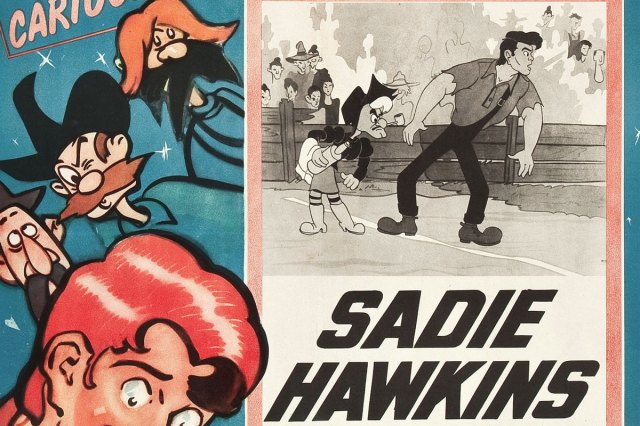
Who Is Sadie Hawkins — And Why Is a Dance Named After Her?
Posted by Sia on January 29, 2026, 2:02 pm ADMIN
Sia: A little American cultural history for fun!
Who Is Sadie Hawkins — And Why Is a Dance Named After Her?
Author Kristina Wright- January 22, 2026
The Sadie Hawkins dance is a familiar tradition to most Americans, best known for the custom of girls asking boys to the dance instead of the other way around. In a world where women run businesses, lead governments, and head nearly half of U.S. households, setting aside one special night for girls to take the lead can feel unnecessary and outdated. Still, the story behind Sadie Hawkins herself offers a fascinating window into Depression-era America and the surprising ways popular culture can shape real-life traditions for generations.
Mind you, Sadie Hawkins wasn’t a real person. She was a comic-strip creation dreamed up in the late 1930s by cartoonist Al Capp for his wildly popular comic Li’l Abner. At its peak, Li’l Abner ran in 900 newspapers in the U.S., and it remained in print until 1977. Set in the rural town of Dogpatch, Kentucky, the strip was filled with broad satire and a large cast of quirky, unforgettable characters. Among them were the handsome and gullible Li’l Abner Yokum, his eternally patient sweetheart Daisy Mae Scragg, the perpetually unlucky Joe Btfsplk, and the scheming industrialist General Bullmoose. But Sadie Hawkins proved to be the character whose antics took her from the comics page into real-life.
Sadie Hawkins Day
Sadie Hawkins first appeared in Li’l Abner on November 15, 1937, initially as a secondary character. She was introduced as the “homeliest gal in all them hills,” an intentionally exaggerated description that played on the intense social pressure for women to marry young. Her father, Mayor Hekzebiah Hawkins, was distressed that Sadie had reached the age of 35 without a husband, a situation he viewed as both humiliating and urgently in need of correction.
To solve the problem, he invented Sadie Hawkins Day, a new local holiday with a peculiar edict. All eligible bachelors were required to run through Dogpatch while Sadie — who was an excellent runner — chased them. According to the rules, any man Sadie managed to catch before sundown was obligated to marry her.
The sight of panicked men sprinting to avoid matrimony while Sadie pursued them delighted readers. Sadie caught — and married — John Jonston, but what began as a one-off gag quickly became one of Li’l Abner’s most memorable storylines, with Capp featuring a new Sadie Hawkins Day race every year until 1952, when Daisy Mae finally caught her beau, Li’l Abner. The Tradition Leaps Off the Page
The popularity of Sadie Hawkins Day quickly spread beyond the comic strip. Readers embraced the idea so enthusiastically that they began organizing real-life versions of the event. The first Sadie Hawkins-themed celebrations were hosted in 1938 and included mock chases inspired directly by the strip, with students dressing up as Li’l Abner characters. Prizes were awarded for the best costumes, and men who were “caught” were expected to accompany the women who caught them to the Sadie Hawkins dance. In 1939, Life magazine reported that 201 colleges and clubs in 188 cities had hosted Sadie Hawkins Day events, and that number grew to more than 500 by 1941.
Over time, the dance became the centerpiece of these celebrations. The events typically featured a reversal of traditional dating norms, with women expected — or at least permitted — to ask men to attend the dance with them. The idea spread so rapidly that many participants assumed Sadie Hawkins was drawn from folklore or history rather than a newspaper cartoon.
A Social Experiment
Sadie Hawkins Day resonated because it tapped into real anxieties about courtship and marriage in early 20th-century America. Marriage was widely viewed as the primary measure of a woman’s success, and unmarried women beyond their 20s were often stigmatized and labeled as spinsters. Al Capp’s exaggerated portrayal of these pressures allowed readers to laugh while still recognizing the social truth beneath the joke.
The Sadie Hawkins storyline inspired a real-life social experiment that revealed how deeply entrenched traditional gender expectations were. By imagining a world where women could pursue men — even if only for a single day — it introduced a socially acceptable framework for a temporary role reversal. For many young women, a Sadie Hawkins dance — sometimes called a “turnabout,” as in the expression “turnabout is fair play” — offered a rare opportunity to take the initiative without defying social norms.
Sadie Hawkins Today
As Sadie Hawkins Day settled into American school culture, it evolved into the dance event most people remember today. Some schools leaned into rustic or comic-inspired themes as a nod to Dogpatch, while others treated it simply as a fun reversal of traditional gender roles. Over time, the direct connection to Li’l Abner faded, but the name endured.
By the 1940s and ’50s, Sadie Hawkins dances had become a widespread social phenomenon that moved beyond college campuses to high schools and community groups across the country. Thousands of schools were hosting Sadie Hawkins or “turnabout” dances each year, making it one of the most common nonholiday social events on American school calendars.
Today, Sadie Hawkins dances are less ubiquitous than they once were, and dating roles have loosened considerably. Many schools have even retired the name, replacing it with events such as MORP dances — “prom” spelled backward — that keep the spirit of role-reversal while dropping the gendered framing altogether.It’s no longer taboo for a woman to ask a man to a dance, and being unmarried doesn’t carry the same stigma it once did. Yet when it comes to proposing marriage, tradition still holds firm. According to a 2022 survey, only 2% percent of heterosexual women in the U.S. propose to their partners. In that sense, Sadie Hawkins’ legacy still lingers, reminding us that while some social rules are easy to rewrite, others take much longer to change.
Re: Who Is Sadie Hawkins — And Why Is a Dance Named After Her?
I hadn't thought about that in a long time. I didn't follow Lil Abner closely but the Sunday Comics were the best because they were in color.
I knew a bit about Sadie from the musical movie and stage play. But had forgotten.
One of my younger cousins (1st once removed) was cast as Daisy Mae in her High School rendition. She was amazing.
When I was in High School my girlfriend went to a different school so I would get a few that would ask and I would struggle with an answer. Some thought my girl was fake and others were like I don't care she doesn't have to know, etc.
I did go as friends a couple times at my school but I always made sure I attended my girls dance at hers.
Even as things change they are still kind of the same.
B-) A Jack of all trades is master of none, but oftentimes better than a master of one.
... And many thanks for the masters in skill for setting our standard of work to instill.
Many of today's bright bulbs can't spell Sadie Hawkins
For starters, they need a newspaper with a comic section, AND they have to know where to look to find it.
Sadie Hawkins dances were popularized in junior high school where girls mature faster and earlier than boys. The name is a metaphor. Many of today's HS graduates can't define or understand a metaphor. They spent their English class time learning how to write a five paragraph essay, because that was how they were tested to be deemed proficient.
If it ain't on the test, it ain't in the classroom!
Some are MAGA and some will see Melania. You can look away from a painting, but you can't listen away from a symphony
Naturally it becomes a rather dull harangues in the hands of a feminist.. SAY ‘NO’ TO WAR! RESIST!
Im not sure what you mean??
Posted by Sia on January 29, 2026, 4:45 pm, in reply to "Li’l Abner?" ADMIN
Kristi Gnoeme is a Twazi
Posted by Pikes Peak 14115 on January 29, 2026, 4:22 pm, in reply to "Li’l Abner?" ADMIN
Nazi twat or twat Nazi.
The felon's appointments were made either by looks, or fealty. You can look away from a painting, but you can't listen away from a symphony
Re: Kristi Gnoeme is a Twazi-- LOL
Posted by jacque on January 29, 2026, 7:59 pm, in reply to "Kristi Gnoeme is a Twazi" Valued Poster
I read Stephen Miller is known as Pee Wee German.
There are some good nicknames for many of them I just can't always remember them when I want to refer to them.A Jack of all trades is master of none, but oftentimes better than a master of one.
... And many thanks for the masters in skill for setting our standard of work to instill.
She's about as pretty as a garbage heap on the kitchen floor
and not at all natural. All kinds of plastic surgery from head to butt. FAKE and meaner'n'a rattlesnake trapped in a burlap sack.
She shot her own puppy for not following her instructions and not meeting expectations. Has she never heard of professional trainers or rehoming unwanted pups?
Murdering that little pup told me ALL I need to know about her. She is unredeemable IMHO.

 on January 29, 2026, 2:02 pm