Trump’s arch of ego
by Steve Schmidt - Oct 17
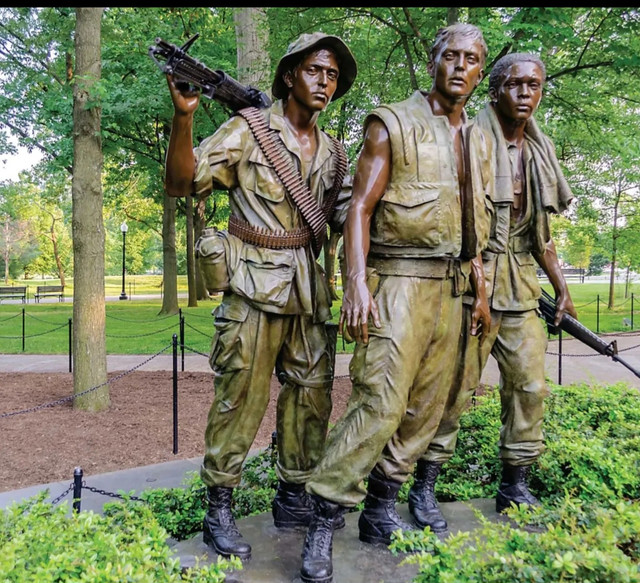
Three young Americans stand watch at the Vietnam Veterans Memorial.
One is Black. One is white. One is Hispanic. Frederick Hart rendered them in bronze, carrying the weapons and equipment of a war whose burden fell heavily on families with little power to escape it. They stand close together, their strength inseparable from their vulnerability. They face the wall.
Look at them. Look at their youth. Look at the devotion captured in their closeness.
Then look at the names.
All of America is on that wall. But America did not bear the sacrifice equally. Its wealth, privilege and connections purchased choices unavailable to millions of ordinary families. The names record individual losses. The pattern of who went, and who was spared, records an injustice.
Donald Trump was spared.
Now he proposes a triumphal arch that would tower over the surrounding memorial landscape. The latest plans call for a structure 250 feet tall at Memorial Circle, across the Potomac from the Lincoln Memorial. It remains subject to review and legal challenges. The intention is already plain enough.
In a landscape that should teach humility, he demands grandeur.
Beside a national reckoning with sacrifice, he wants a spectacle.
The arch would not stand directly over the Vietnam wall. The shadow I am describing is moral: the vanity of a man whose privilege spared him the war, imposed upon a landscape where Americans come to remember what that war took.
Hart’s soldiers ask us to consider what human beings owe one another. Trump’s arch would ask us to admire the man who ordered it built.
Public service has become, in his hands, a license for taking.
Service means something. It means accepting an obligation greater than appetite. It means understanding that the authority to command another human being carries a responsibility that cannot be discharged with a salute, a slogan or a photograph.
Leaders eat last. They accept responsibility first. They bear inconvenience before imposing hardship. They listen when the news is unwelcome. They demand evidence before making promises. Before sending someone else’s child to war, they exhaust the alternatives and confront the possibility that their own judgment is wrong.
The wall is a permanent instruction in that possibility.
More than 58,000 American service members died in the Vietnam War. More than 153,000 suffered nonfatal wounds. Countless others returned carrying injuries that followed them through marriages, jobs, sleepless nights and the long, private struggle to live after surviving.
The Vietnamese dead must be part of this reckoning. Estimates vary; commonly cited figures include as many as two million civilians, approximately 1.1 million North Vietnamese and Viet Cong fighters, and up to 250,000 South Vietnamese service members.
Parents buried children. Children lost parents. Communities were shattered. Their lives carried the same human worth as ours. Their suffering cannot be relegated to the background of an American lesson.
The scale of that catastrophe should chastise anyone who speaks easily about war.
Not so long ago, the wheelchairs arriving at Washington’s memorials carried the old veterans of World War II. Now the men who fought in Vietnam are old. Many return in wheelchairs to visit friends who never grew old at all.
A man approaches a name. He remembers a voice. Perhaps he remembers the last thing that voice said.
Half a century has passed. The absence has remained.
What kind of leader looks upon that landscape and concludes that what it needs is a monument to triumph? No Vietnam veteran has been elected president. Al Gore, John Kerry and John McCain served there. Each became his party’s presidential nominee. Each lost.
George W. Bush served in the Air National Guard, but never in Vietnam. Bill Clinton, Barack Obama, Donald Trump and Joe Biden never served in the military. These distinctions matter. So does the larger truth: a country that demands extraordinary sacrifice from some families has repeatedly entrusted its highest office to men spared that particular burden.
Military service does not guarantee wisdom. Its absence does not make wisdom impossible. But the obligation to acquire humility rests on every commander in chief.
Bush’s Iraq invasion was a strategic disaster. Trump’s war with Iran demands its own accounting. The danger of escalation into a wider war should haunt every decision. A third world war is a calamity to prevent, never a gamble to take with other people’s children.
Consider the sailors aboard the USS Abraham Lincoln.
They returned to San Diego on October 8 after 321 days deployed — nearly eleven months. Their ordeal included reported shortages of fresh food and plumbing problems.
Asked in August whether the deployment had gone on too long, Donald Trump answered:
No, no, no. Not nearly long enough.
Read/listen to that again.
Not nearly long enough.
Someone waiting for a spouse had waited nearly long enough. Someone’s child had spent nearly long enough asking when a parent would come home. Someone working through exhaustion had endured nearly long enough.
The president’s answer was more.
There is a distance between possessing the power to extend a deployment and understanding the human beings whose lives that extension consumes. A decent commander in chief works every day to close it. Trump’s remark revealed how casually he inhabits it.
That distance runs through our politics.
Democrats must reckon with their own failures. The theory that a younger, more diverse, more educated electorate would make working-class white voters dispensable was morally bankrupt and politically reckless. Barack Obama won voters his party subsequently lost. A winning coalition requires the work of persuasion; demographic change does not relieve a party of that obligation.
Working people cannot be treated as yesterday’s constituency, awaiting replacement by a more fashionable electorate.
Nor should anyone pretend that race leaves Americans with nothing in common. Racial injustice is real. It must be confronted. It does not erase shared needs, shared obligations or the possibility of solidarity.
Look at those three soldiers. Their differences are visible. Their dependence on one another is visible too.
A politics that cannot recognize both has misunderstood the country it seeks to govern.
Black, white and Hispanic parents want their children to live. They want work that supports a family, a home they can afford, decent schools and medical care that does not destroy their savings. They want the people making decisions about their communities to answer to the people living with the consequences.
They do not want their children used as cannon fodder in the schemes of privileged men.
They do not want a corporation consuming their community’s water, burdening its electricity supply or exposing their neighborhood to pollution while officials tell them to celebrate somebody else’s fortune. Data centers must answer for their demands on water and power and the emissions from their generating equipment. Residents deserve enforceable protections and a meaningful voice.
The connection is who decides, who benefits, and who bears the cost.
Too often, the benefits travel upward while the costs arrive at a working family’s door.
Democrats must stand at that door.
They must earn the trust of families across race and region through conduct: protecting their health, defending their livelihoods, respecting their communities and refusing to spend their children’s lives carelessly.
That is the majority worth assembling. It will require persuasion, discipline and a commitment that survives Election Day.
Donald Trump should be repudiated at the ballot box. Congress should hold his administration accountable. And if his arch is built, a Democratic president and Congress taking office in 2029 should authorize its lawful removal and the restoration of the landscape.
Make the case publicly. Debate it. Vote on it. Remove it.
A president’s vanity creates no obligation of permanence.
The young men in bronze will still be there. So will the names.
Receive the old veterans with gratitude. Listen while there is time. Learn what the wall has been trying to teach us.
Leaders eat last.
Any president who cannot understand that has no business asking Americans to give everything.
The Warning: your turn What does it say about America when a president who avoided the Vietnam War wants to build a monument to his own grandeur near the memorials honoring those who died?
Is this simply another display of Trump’s vanity — or evidence of something more troubling about how America now understands leadership, service and sacrifice?
I want to hear what you think in the comments.
“Dead Air:” The Buddy System with Steve Schmidt & Dean Blundell
Today at 12 pm ET, Dean Blundell and I kick things off in Indiana, where city council candidate Jamie West has taken the internet by storm. Our advice? Keep being yourself.
Then it's off to the White House, where officials say an order came down to slow Ukraine's Starshield service. Apparently, helping Putin is higher on the priority list than helping America's allies. I say Ukraine is winning this war and will win it. Meanwhile, Americans are getting robbed at the gas pump while Trump makes deals with Putin, sending money Russia's way as Iran relies on Russian and Chinese technology to attack American troops. We also have a suggestion for the next Democratic Speaker of the House: Don't invite Trump to deliver the State of the Union. Give the microphone to Mark Carney, Zelensky, and Pope Leo. And I have one final message for MAGA: We won. You lost. Our mandate is to restrain you. Don’t miss it. Brought to you by The Save America Movement. No kings. No crowns. No monuments to vanity.
Today, Americans are gathering across the country to deliver a message that should never need repeating:
America has no kings.
Donald Trump wants a triumphal arch. The American people want leaders who understand that public office is a responsibility, not a throne.
The Vietnam Veterans Memorial honors sacrifice. Trump’s proposed monument celebrates power and personal grandeur.

 on October 18, 2026, 4:43 am


