Monkton, to the south east of Hebburn Hall was traditionally the birthplace of St Bede, but in recent times it has been shown that Bede gave his birthplace as Sunderland. Though absorbed by Jarrow, some stone houses of Monkton village survive including old farmhouses and an 18th century house called Bede Cottage.
To the north of the village is a large open green area which was previously a large Slag Heap created in the 1800s by the dumping of liquid slag from Palmer’s Blast Furnaces.The molten slag was transported on rail tracks and dumped when still liquid. In the 1950s the Slag Heap was around 100 ft high. Sadly the dumping of the slag probably took its toll on Bede's Well which was alongside the Hebburn end of the slag heap.
Once a destination for a day out for people in the neighbourhood the Well or Spring which is rightly or wrongly associated with Bede was thought to have remarkable properties that enabled the healing of sick children. In the 1700s it seems to have hosted some kind of midsummer festival for local folk so evidently a site of much curiosity. The ‘Well’ can still be seen, but it is little more than a square-shaped patch of stone alongside a path within a circular grove surrounded by trees now 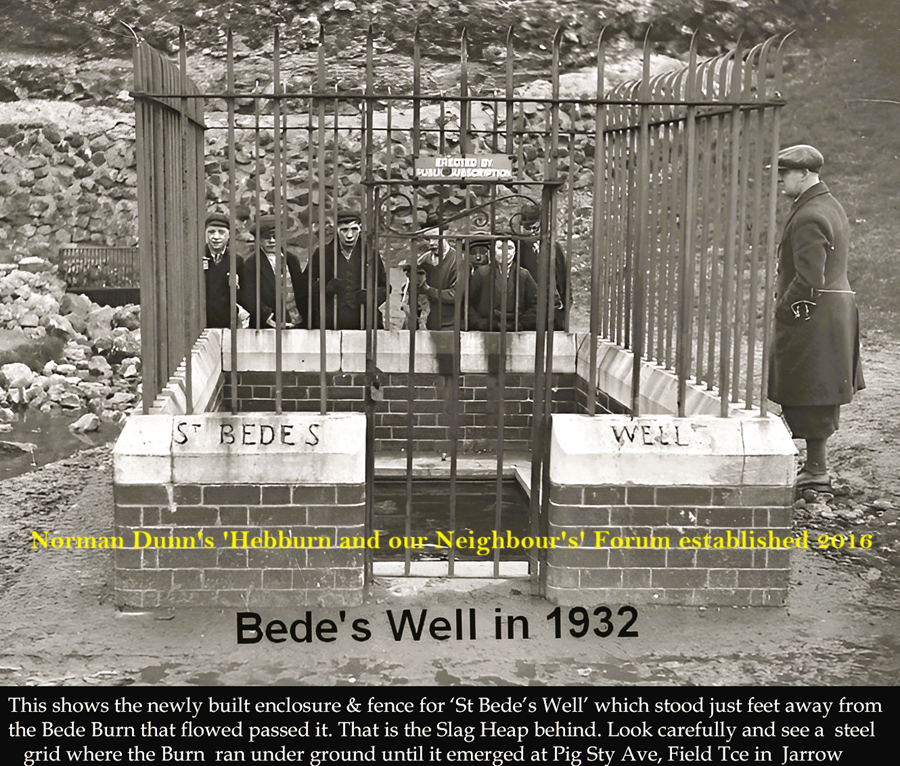
Very close to Bede’s Well towards Hebburn Hall were four lakes created on their own farmland in the mid to late 19th century by the Ellison family. The Ellison’s decided on the shape they wanted the Lakes to be & had clay embankments laid out with large sandstone rocks from the local quarry re-enforcing them. When the work was completed the little Burn (stream) that had ran from Wardley area to the River Don area of Jarrow for thousands of years was diverted to fill the 4 new lakes. At this time,what we call ‘Hebburn Park’ was the Ellison’s private gardens & these new Lakes were their private ponds to be used only by them for boating, fishing & entertaining wealthy friends and business associates.
In the late 1890s the Ellison family handed over their private gardens & ponds to Hebburn Urban District Council to be used by the people of the town for leisure purposes. Many years later on a cold winter’s day in 1957, three young children living close to the 4th lake (known locally as ‘Sandy Bottom’) went playing on the ice and because it was thin ice it gave way and all three children sadly drowned. Hebburn Council soon decided that the 4 lakes had to be drained and soon afterwards new roads, schools and houses were built directly on that land.
Hope you enjoyed my History Lesson,
Norman Dunn


Message Thread

« Index | View all »