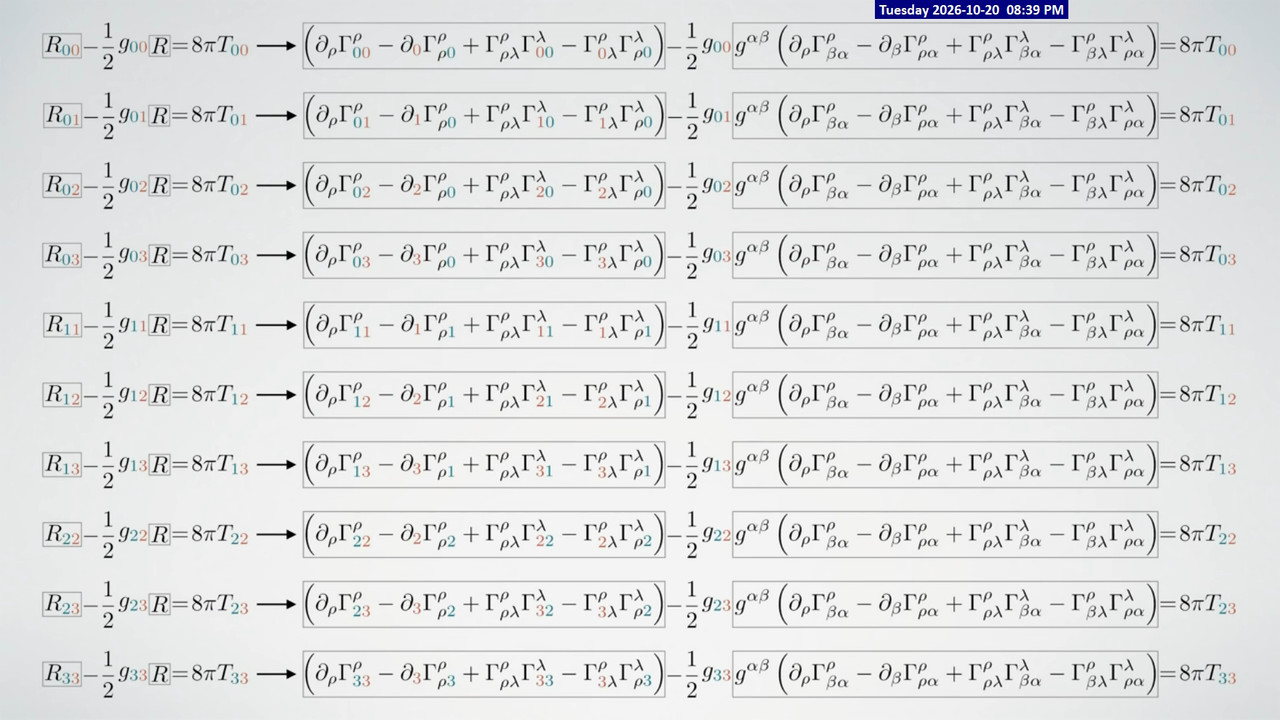
Why is GR important? Because, without GR, our GPS would not work. GR says that time slows down inside a gravitational well, like that surrounding the Earth. This means that the orbiting clocks which form the heart of GPS run slightly FASTER than clocks on the Earth. The difference is highly significant, because without including GR corrections, GPS would drift by kilometers EVERY DAY, and thereby become USELESS.
From Google:
The Global Positioning System (GPS) relies on Einstein's theories of relativity because atomic clocks on GPS satellites and clocks on Earth tick at different rates.
How Relativity Affects GPS Clocks
• General Relativity (Gravity): GPS satellites orbit about 20,000 km above Earth, where Earth's gravity is much weaker. According to general relativity, weaker gravity causes atomic clocks to tick faster, gaining about +45 microseconds per day. • Special Relativity (Speed): Satellites travel at high speeds of about 14,000 km/h (4 km/s). According to special relativity, motion causes clocks to tick slower, losing about -7 microseconds per day. • Net Difference: Combining both effects, a satellite clock runs +38 microseconds faster each day than a clock on the ground.
Why This Matters for Accuracy
• Radio signals travel at the speed of light (~300,000 km/s). • A timing error of 38 microseconds accumulates into a positional error of roughly 10 to 11 kilometers per day if left uncorrected.
How Engineers Fix It
• Before launching into orbit, engineers adjust the satellite clock frequencies downward from a nominal 10.23 MHz to 10.22999999543 MHz. • This factory frequency offset counteracts the relativistic drift so that once the clocks are in space, they tick in exact synchronization with ground clocks.