On the day he died, a doctor told Tom Petty the hip had finally broken all the way through. That was October 2, 2017. His last concert had been seven days earlier.
He grew up in the Duckpond, a few streets northeast of downtown Gainesville. His father Earl was a traveling salesman who drank, and who took it out on his oldest son. He was around five the first time. "He beat me so bad that I was covered in raised welts, from my head to my toes," he told his biographer, Warren Zanes.
Then came July 1961. His uncle was working on a movie set down in Ocala, and brought the family to watch. A 10-year-old boy stood in a crowd of hundreds outside a bank on East Silver Springs Boulevard and saw Elvis Presley. He went home that night and started hunting for records. He was out of that house from that day on, in every way that counted.
He never went to the University of Florida. He dug graves for a while. He worked the UF grounds crew, cutting grass outside classrooms he was not enrolled in.
Then California. Then the Heartbreakers. Then a run of songs an entire country memorized without meaning to.
In 1981 his record label wanted to charge a dollar more for his new album. Petty refused, threatened to name the record Eight Ninety-Eight, and would not hand over the tapes. He was a rock star in his thirties picking a fight he could only lose money on. The label backed down. The people who bought that album paid the old price and never knew why.
May 17, 1987. Someone cut a hole in the fence behind his house, sat there and WATCHED it for a while, then came down before dawn and set the back staircase on fire with lighter fluid. The house burned to the ground. His family got out. Nobody was ever arrested.
The song he and Jeff Lynne wrote afterward was about standing your ground and refusing to be moved. Ten days after September 11th, nearly 60 million Americans watched him sing it on a telethon.
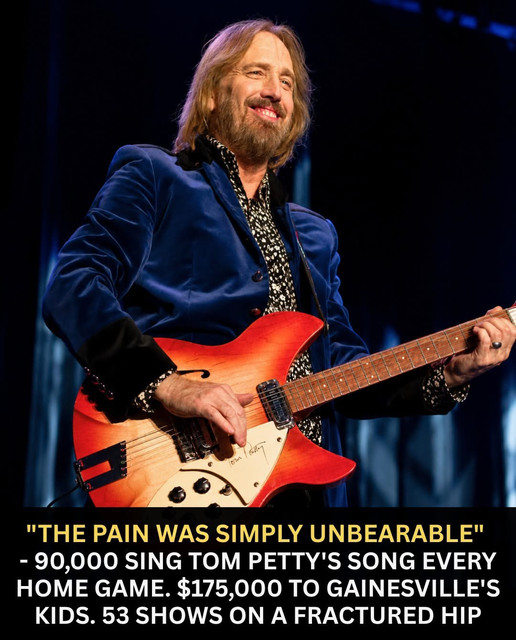
In 2017 he went out for the 40th anniversary tour on a hip that was already fractured. Fifty-three dates. His family later said it worsened while he stood on it, night after night, and that "he insisted on keeping his commitment to his fans."
He finished the tour. Seven days later he was gone.
He wrote the song a country uses to keep going. Then he kept going, and it killed him.
Five days after he died, the stadium in his hometown put that song on the speakers between the third and fourth quarters. Ninety thousand people sang along without being asked twice. It has played at every Gators home game since.
That same week somebody drove out to the 34th Street wall, the slab of concrete Gainesville kids have been painting on their whole lives, and wrote: "Love you always, Gainesville No. 1 Son, Thanks, Tommy." Every town has a wall like that. Every kid has a first song and a road they learned it on.
Then May 4, 2023. The University of Florida called his name at spring commencement, and his little brother Bruce walked across the stage to take the degree for him. Doctor of Music. "It was his life-long dream," Bruce said.
The kid who cut that grass is Dr. Tom Petty.
His family kept handing it back. A hundred thousand dollars to start an endowment for guitar students at that school. A hundred and seventy-five thousand from one Tom Petty Day at the stadium, split between Kids Count and Family Promise, early education for local kids and families climbing out of homelessness. The park on 16th Avenue carries his name. Gainesville still throws him a weekend every fall.
Every home game, the third quarter ends and ninety thousand people sing about not giving in. Most of them are singing about something in their own life. A diagnosis. A landlord. A father.
That is what Tom Petty actually left Florida. Not a hit record. Something to hold on the worst day of your week.
He kept the promise. The whole state learned the words.


Message Thread
