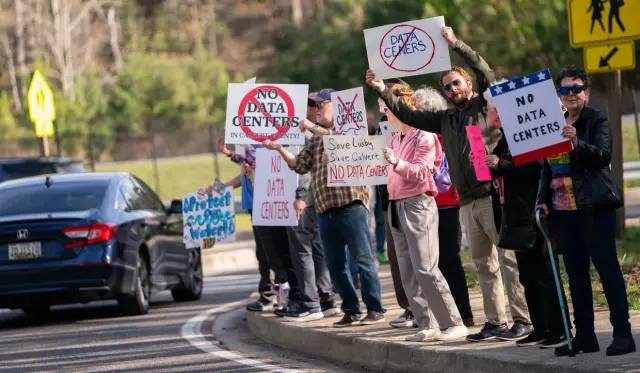
Americans seek dignity, and the AI revolution poses a threat to it.
The late Shelby Foote told a story, memorialized in the 1990 Ken Burns documentary The Civil War, of a Southern soldier, captured by Union forces, who was asked why he was fighting. The rebel, a defeated partisan of a plainly doomed cause, did not respond with any sophisticated theory or political apologetics. Why was he fighting? “Because you’re here,” he said.
In a very different time, this captures the essence of the anxiety and opposition to artificial intelligence and data centers among our neighbors in America’s conservative and rural communities. Though it is unquestionably true that some of this opposition is astroturfed, generated by competing interests and/or supported by foreign actors, it is not created by them, and it would exist without them. It is also true that much of the opposition centers on questions of resources, especially water and electricity, which are empirically answerable. Yet to treat these as arguments to be proven or disproven is to miss why they are being made at all.
China’s agents could stop funding anti-AI, anti-data-center agitation altogether, AI vehicles could be proven exponentially safer than human-driven cars, and data centers could be shown to drive down electricity and water prices, and the unease and dislike of them would persist. The thing it’s about is not really what it’s about.
What it’s about is, as Foote’s soldier said, the fact that they’re here. This summer marked the eleventh anniversary of the golden-escalator ride that plunged America into the populist moment, and by now we ought to understand that Americans have long been on the precipice of dizzying change — and not for the better. The advent of the information age has yielded exactly the opposite of many optimistic predictions made a generation ago. Society is digitally interconnected, yet this has promoted vastly more friction than understanding. The sum of human knowledge is available in a pocket-sized device to nearly everyone, yet ignorance is more robust than ever. Participatory democracy is easier than it has ever been, yet governance does not work nearly as well as it did in our fathers’ time. The net effect of social media and the information age on the American way of life seems to be that it has made it much worse.
https://www.nationalreview.com/2026/09/what-the-data-center-revolt-is-really-about/


Message Thread

« Index | View all »