GRAM PARSONS: THE WAYCROSS BOY WHO CHANGED AMERICAN MUSIC
There are people who become famous because they sell millions of records. There are people who become famous because they have the biggest hit songs. And then there are people who become something else entirely. They become a bridge. They connect one generation to another, one musical tradition to another, one culture to another. Gram Parsons was one of those people.
Before he played with The Byrds, before he helped create the Flying Burrito Brothers, before he became friends with Keith Richards, before Emmylou Harris became one of the most respected voices in American music, and before the strange mythology surrounding his death became part of rock-and-roll history, Gram Parsons was a young boy growing up in Waycross, Georgia.
That part of his story matters.
Gram Parsons was born Ingram Cecil Connor III on November 5, 1946, in Winter Haven, Florida. He wasn't technically born in Waycross, but he spent his formative childhood years here after his family moved to South Georgia. His mother, Avis Snively, came from a wealthy Florida citrus family. His father, Ingram Cecil Connor II, was a World War II veteran and former Air Force major.
The family had money, but Gram's childhood was complicated by alcoholism and tragedy. His father eventually ran the Snively family's crate-production plant in Waycross.
For Gram, Waycross became home. He would later be described as the **“Waif from Waycross.”** The musical environment surrounding him in South Georgia would become incredibly important to the man he eventually became. He heard country music on the radio. He heard Southern gospel and church hymns. He was exposed to rhythm and blues and soul music. He listened to the sounds of the South without seeing them as separate musical worlds.
That would become one of the defining ideas of his life.
In 1956, something happened that changed everything. Gram was ten years old when **Elvis Presley came to the Waycross City Auditorium.** Elvis wasn't yet the universally recognized King of Rock and Roll. He was a young and controversial performer who was combining country music, rhythm and blues and rock and roll into something new.
Gram was in the audience. He watched Elvis walk onto the stage, and something clicked. For a young boy already fascinated by music, Elvis demonstrated something that Parsons would spend the rest of his life pursuing: musical boundaries didn't have to exist. Country could mix with rock. Rock could borrow from rhythm and blues. Gospel could influence everything.
Music could bring completely different worlds together.
After seeing Elvis, Gram became obsessed. He performed on his front porch. He imitated Elvis. He recruited neighborhood children into his little bands. Even his younger sister was pressed into service. He was still a child, but he was already learning how performance worked, how music made people feel, and how an audience could be moved by a performer.
Then tragedy entered his life.
In December 1958, when Gram was only twelve years old, his father died by suicide in the family's Waycross home. The family had been away in Florida for Christmas. His father had given Gram a reel-to-reel tape recorder and recorded messages from Gram's friends. He also left a message telling his son that he loved him.
It was one of the last things Gram had from his father. The loss devastated him.
His mother later remarried, and the family eventually moved away from Waycross. Her alcoholism worsened, and Gram increasingly turned toward music. Music became the place where he could escape. It became the place where he could make sense of things.
Then came another devastating loss. Gram's mother died from complications related to alcoholism on the very day he graduated from high school. By the time he was barely out of his teenage years, Gram Parsons had lost both of his parents.
Those losses would echo through his music for the rest of his life. You can hear it particularly clearly in one of his most famous songs, **“Hickory Wind.”**
The song is about longing for home. And knowing that the songwriter had spent his childhood in South Georgia, lost his father in his Waycross home, lost his mother on his graduation day, and would spend much of his adult life moving from place to place gives the song an entirely different weight. It isn't simply a song about geography. It sounds like a man trying to find his way back to something that existed mostly in memory.
As a teenager, Parsons began playing music professionally. He formed bands, played rock and roll and folk music, and absorbed artists such as Ray Charles, Chuck Berry and Little Richard. Eventually, his musical journey took him to **Harvard University**.
Yes, the boy from Waycross ended up at Harvard.
But Gram wasn't destined for a conventional academic career. He arrived with a guitar and quickly assembled a band that became the International Submarine Band. During this period he began rediscovering something many young Americans in the 1960s were moving away from: **country music.**
To Parsons, country wasn't old-fashioned. It was emotional. It was honest. It told stories about heartbreak, loneliness, faith, family, work and loss. He began to understand that country music had something the rock world desperately needed.
But he didn't want to simply copy the past. He wanted to bring it into the future.
Eventually, Parsons left Harvard and headed toward California. That's where his musical vision really began to take shape.
In 1968, he joined **The Byrds**, one of America's most important rock bands. He helped push them in a direction few major rock groups had gone before: country.
The Byrds traveled to Nashville and recorded what became one of the landmark albums in the development of country-rock, *Sweetheart of the Rodeo*. Parsons contributed songs including **“Hickory Wind,”** and the album helped introduce country music to a generation of rock listeners.
The Byrds even appeared at the Grand Ole Opry. And not everyone in the country music establishment knew what to make of them. These were long-haired California rock musicians walking into Nashville and playing country music.
But that was exactly what Gram Parsons wanted. He wanted to tear down the walls.
After leaving The Byrds, Parsons and Chris Hillman formed the **Flying Burrito Brothers**. Their 1969 album, *The Gilded Palace of Sin*, became another landmark. It combined traditional country, pedal steel guitar, rock, rhythm and blues and the counterculture of the 1960s.
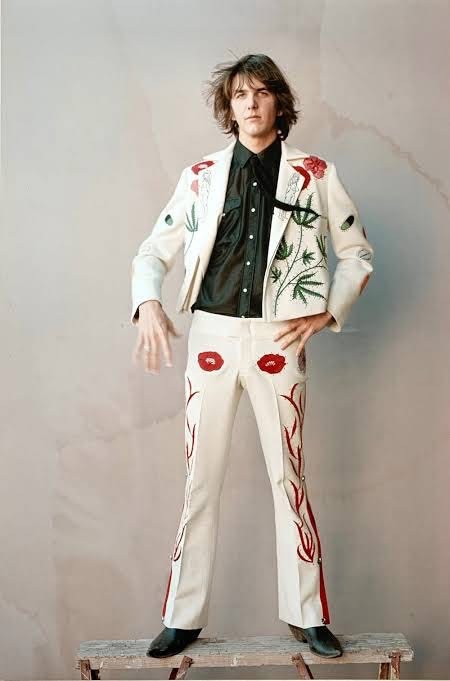
Parsons even wore the now-famous rhinestone Nudie suits created by legendary tailor Nudie Cohn. He looked like a country star from another universe. And that was kind of the point.
Gram Parsons called his musical vision **“Cosmic American Music.”** He believed American music didn't need to remain divided into neat categories. Country. Rock. Blues. Gospel. Soul. Folk. They were all part of the same American musical story.
One of the people who came to understand that vision was **Keith Richards of the Rolling Stones.** Parsons and Richards became friends and spent time listening to country records together. Parsons introduced Richards to the depth and variety of American country music, including the differences between the Nashville and Bakersfield traditions. The influence eventually found its way into the Rolling Stones' music.
That's one of the remarkable things about Gram Parsons. He wasn't always the biggest star in the room. But musicians listened to him. Great musicians listened to him.
Then came **Emmylou Harris.**
When Parsons met her, Harris wasn't yet the country music legend she would become. She was a relatively unknown singer. Parsons heard something in her voice and brought her into his musical world.
Together they recorded *GP* and then *Grievous Angel*. Their voices created something special—Parsons's rough, vulnerable delivery alongside Harris's extraordinary harmonies. Harris would go on to become one of the most respected singers in American music. Parsons helped open the door. She walked through it.
But Gram Parsons was not a perfect man. He struggled with drugs and alcohol. He could be arrogant, reckless and difficult.
His personal life could be chaotic, and his addictions increasingly interfered with his career and relationships.
It's important to remember that. Turning him into a flawless musical martyr would actually make his story less interesting. He was complicated. He was brilliant. He was wounded. He was ambitious. He could be generous and selfish, inspiring and frustrating. He was human.
And he was running out of time.
In 1973, Parsons was working on what would become *Grievous Angel*. He was only 26 years old. On September 19, 1973, while staying at the Joshua Tree Inn in California, Gram Parsons died from an overdose involving morphine and alcohol.
Twenty-six years old.
That's an almost impossible number to comprehend.
The boy who had grown up in Waycross was gone.
But the story wasn't quite finished.
Parsons had reportedly told his friend and road manager, Phil Kaufman, that he wanted his remains cremated and his ashes scattered at Joshua Tree. His family had other plans and arranged for his body to be transported to Louisiana.
Kaufman decided to honor what he believed was Parsons's final wish. He and a friend obtained a hearse, intercepted the coffin at the Los Angeles airport and drove it into the California desert. At Joshua Tree, they attempted to burn the coffin and Parsons's body.
The bizarre incident became one of the strangest stories in rock-and-roll history.
But here's the thing: **That isn't really the story of Gram Parsons.**
It's the strange ending. It's the mythology. It's the part people remember because it's outrageous.
The real story is much bigger.
After Parsons died, his influence continued to grow. Musicians discovered his records. Country-rock evolved. Americana eventually emerged. Alternative country found a foundation. The Eagles absorbed many of the musical ideas Parsons had pioneered. Emmylou Harris carried his influence forward. Keith Richards continued to acknowledge what Parsons had taught him about country music.
Generation after generation of musicians discovered this strange, brilliant 26-year-old who believed American music didn't have to live inside a box.
And in 2026, the **Rock & Roll Hall of Fame recognized Gram Parsons as part of its new class**, decades after his death.
That's remarkable when you consider how short his career actually was. He didn't live long enough to see the musical movements he helped inspire. He didn't see Americana become a major musical genre. He didn't see the careers that his influence helped shape. He didn't get to grow old. He didn't get to become the elder statesman of American music he might have been.
He simply ran out of time.
And that's why his connection to Waycross is worth remembering.
Gram Parsons wasn't born here. But he **grew up here.**
The sounds that shaped him were here. The South Georgia culture that became part of his identity was here. And the night that helped change the direction of his musical life happened here.
A ten-year-old boy sat inside the Waycross City Auditorium and watched Elvis Presley walk onto a stage. He heard country. He heard rhythm and blues. He heard rock and roll. And somewhere inside that boy, an idea began to form.
Maybe these things didn't have to be separated.
Maybe they could become something new.
Years later, he would take that idea to Harvard, to California, to Nashville, to The Byrds, to the Flying Burrito Brothers, to Keith Richards, to Emmylou Harris and eventually to the world.
All from a boy who grew up among the pine trees of South Georgia.
So the next time you hear the name **Gram Parsons**, don't think first about the drugs. Don't think first about the stolen hearse. Don't think first about the bizarre ending in the California desert.
Think about the boy.
Think about the Waycross City Auditorium.
Think about Elvis walking onto that stage in 1956.
Think about a young South Georgia kid hearing all these different sounds and eventually deciding they belonged together.
Gram Parsons called his vision **Cosmic American Music.**
He only lived 26 years.
But those 26 years were enough to change the direction of American music.
And that's a pretty remarkable piece of history for **Waycross, Georgia.**
🎸 **The boy from Waycross didn't become legendary because he followed the rules. He became legendary because he changed them.**
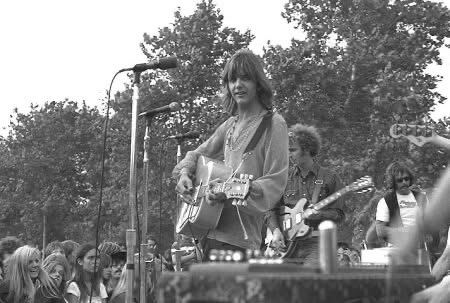
*First picture is Gram playing in Waycross.

Millwood Historical Society

