
They are somewhat baffling in that so many items of décor from the so-called Art Deco period command absolutely stupid prices, while these can be had for easy money if you are a little patient and a little observant.
Here are two examples. This one is the earlier, dating probably from the early to mid-'30s. It was made by Kodel Electric Company, who originally made radios. Badged as "Kenmore", one instantly assumes an association with Sears, Roebuck, and Co. who used the Kenmore label extensively as their "house" branding. Not the case, here.
The case is a solid Bakelite case and the movement is interesting because there is a spinner you need to twirl on the back to actually start the clock after plugging it in. Also, the hole in the face under the 12 has a revolving dial behind it showing the elapsed seconds in ten-second increments, rather than having a second hand.
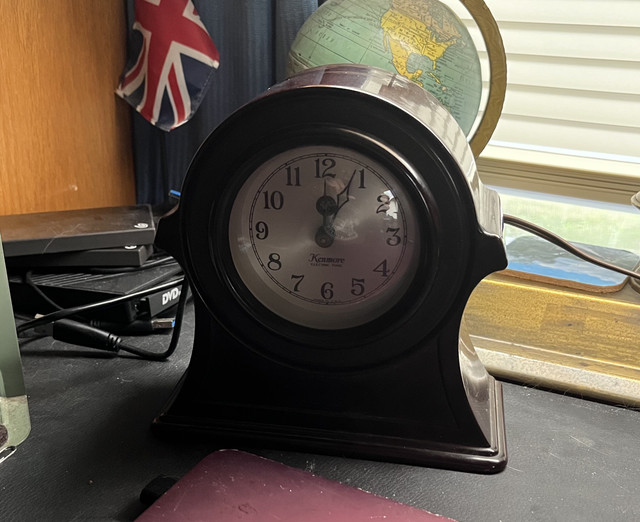
The design is more the earlier French Deco style, and makes for a very cool clock.
The second one is by Hammond, the same Hammond who would become very successful after the war as a maker of electric organs for the home. His is also a spin-start movement, beautifully machined. He believed the movement should be made of top-quality components, yet able to be easily assembled by unskilled workers. I actually bought this some years ago in beat up condition with a cracked glass at a jumble for very little money, not realising it (or any electric clock) had to be spin-started. It sat in my shop for years waiting for me to do something with it, and surfaced again during a tidy-up exercise.
Once I figured out the starting procedure, I took it apart, cleaned it up, re-assembled it (remember the bit about easy assembly for the unskilled? GRIN!), cleaned up the case (solidly made of several different woods), got a picture-frame shop to cut me a new glass, and its been on my desk in the library ever since.

It is more Art Moderne in style, what people imagine when they hear someone talking of Deco, and dates from the late 1930s. What a difference five or so years make in the design styles of the period!
Both Hammond and Kodel got in legal trouble with their designs as another maker called Telechron filed patent on their electric clock design, conceptually general enough that infringement was perhaps too easy to judge in court. Both Hammond and Kodel disappeared or moved on from clocks at the American entry to the war and after a few court fights. It didn't help that Telechron was associated with General Electric.


Message Thread  And talking about clocks... - sarge July 27, 2026, 12:45 pm

« Index