
 on February 23, 2026, 11:37 am
At the Spot Where Alex Pretti Was Killed “Any righteous person would have done the same.”
by Sam Stein, Andrew Egger, and Jim Swift
- Feb 23
We don’t know about you, but we’ve found it a little trickier than usual to summon a spirit of uncomplicated, leave-it-all-on-the-dance-floor, red-white-and-blue patriotism these days. But after a magical few days for America to close out the Winter Olympics—from Alysa Liu’s breathtaking gold-medal figure-skating performance to the gold-medal hockey wins for the American men and women (both in overtime!)—we were fist-pumping along with Mike Tirico’s Olympics signoff for NBC yesterday: “For all the young people out there, those dreams are formed now. Go chase them and go get them, because our country loves sports and it brings us together unlike anything else.”
Plenty of time ahead to get jaded again. But first, just once more, with feeling: USA! USA! USA!
Now we return to the bleaker parts of our reality. Happy Monday.
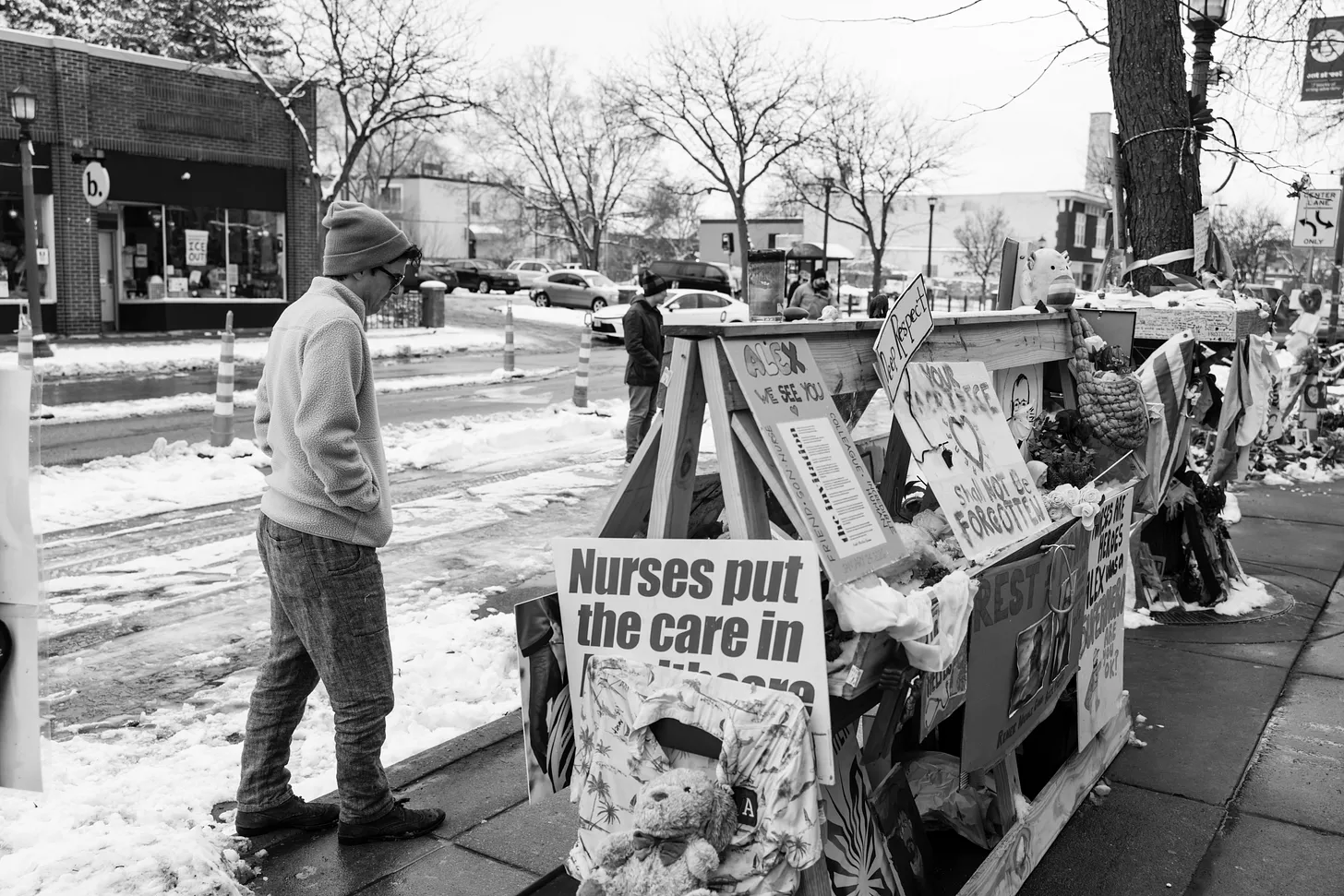
Tim at the Alex Pretti memorial in Minneapolis (Photo by Northstar Imagery)
At Alex Pretti’s Memorial
by Sam Stein
One of the more unsettling elements of the Alex Pretti memorial site in Minneapolis is how unexpectedly it arrives on you. Driving down Nicollet Avenue, you see few indications it’s near save for subtle atmospherics: The streets seem more bare, and pedestrians offer the occasional nervous glance around for nearby agents.
When you get to the site, you find just a slab of street, no longer than two parking spots, blocked off by traffic cones and tape. Flowers are strewn across the sidewalk, some falling onto the pavement. There are posters and signs and mementos. A nurse’s uniform with a stethoscope looped over it has been affixed to a wall, with “Freedom is not free – Alex Pretti” written in black marker on the front. A black banner stretches between two lampposts; its inscription, in a biblical-looking white block font, says “REST IN POWER ALEX / ANY RIGHTEOUS PERSON WOULD HAVE DONE THE SAME.” An American flag hangs sluggishly off the rope anchoring one corner of the banner, as if it was burdened by what happened that day in January. There are crosses and beads and a window in the background that is covered in post-it notes. So many post-it notes.
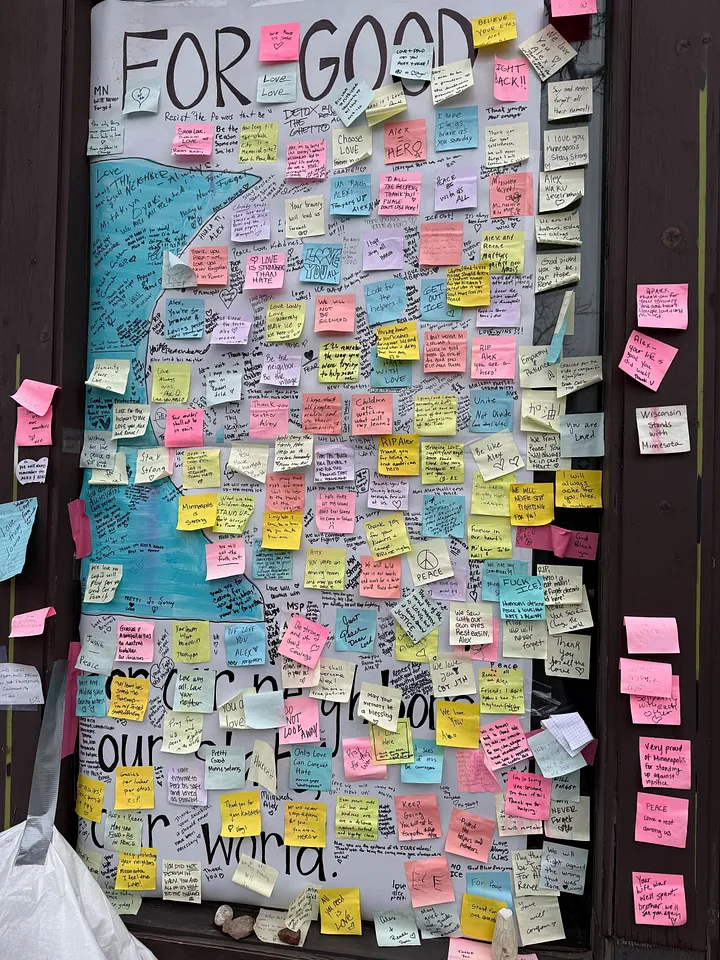
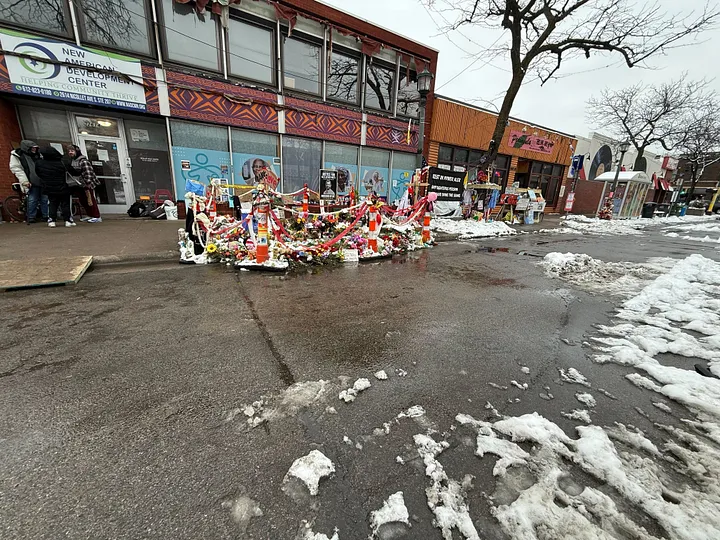
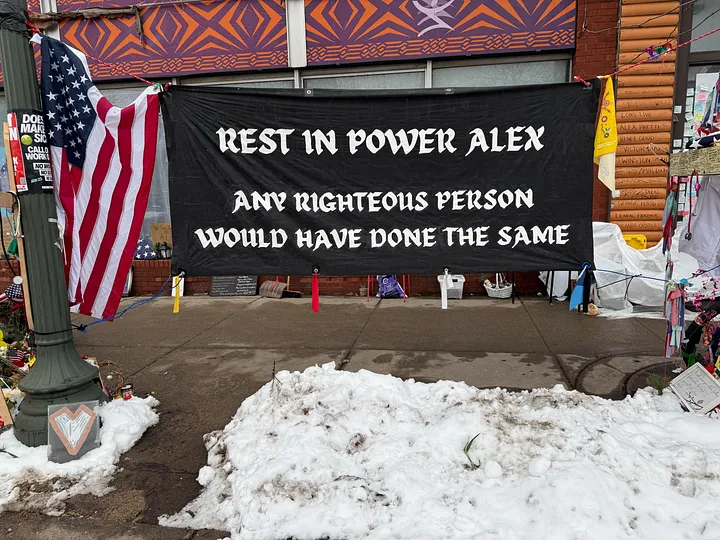
(Photos by Sam Stein)
“I hope people at my school don’t feel scared to come to school  “ reads one in pink.
“I pray (and I don’t normally do that) that we will have an ounce of the courage and compassion of Mr. Pretti,” reads a yellow square. “Alex, thank you for being brave enough for all of us ❤️” reads a purple one.
It’s been more than a month since Pretti was killed while protesting ICE. And while the Trump administration has since drawn down its deployment of agents to Minneapolis, the people who live here don’t feel as though things have changed. One Uber driver I spoke to—a Somali American with U.S. citizenship—said he’d been pulled over three times since the killing. Each time, an ICE agent claimed he looked like someone they’d flagged as being in the country illegally. They searched his car even after he produced papers; he now doesn’t drive without them. In one instance, he was held for 40 minutes before they let him go. In another, a customer sat in the backseat as the interrogation took place.
These experiences are now part of the well-understood pattern of life in a city under ICE occupation. The psychic effects, though, are harder to describe. One man I spoke with had begun volunteering to help form physical human barricades around crosswalks to protect children going to school. He said he felt spiritually called to the task. But it unnerved him, too. The children, he told me, often feared that he might be an ICE agent in disguise.
Pretti’s memorial draws people from within the city and outside of it. Two men were standing watch there the day I showed up. Micah Stewart, 22, saw video of the killing on his phone and felt immediately compelled to go to Minneapolis. So he hitchhiked from his home state of Washington. It took him about five days. He now stays overnight at the memorial site, except when it gets too cold and he boards with locals he has met. He told me that Pretti’s friends and relatives have come by to see it. But they do it with no fanfare, not wanting to be noticed.
Alongside Stewart was Bobby Fitzpatrick, 56, a Minneapolis resident of ten years. He stays around the site through the day and night, often until 2 or 3 in the morning. “It means something,” he said. “It touches anyone who has a heart.”
The site takes about ten minutes to reach by car from downtown Minneapolis, if that. Its setting is the kind you could envision in any other city: A sliver of life for people who enjoy the melding of cultures and a bit of urban vitality.
Within a one block radius of the memorial, there is a German restaurant, a Malaysian place, and a family-run Vietnamese sandwich shop. Across the street, next to the now-famous Glam Donut shop, is a hipster thrift store with racks of vintage shirts and pants and coats and banana pudding–colored walls covered with stacks of sunglasses and jewelry. There’s art on those walls, and disco balls hang from the ceiling, and signs touting political causes and community events have been plastered throughout. And on the day I visited, a guitarist and a singer performed a protest song that seemed more like an elegy.
We are all connected.
Can’t you see?
None of us are free, till all of us are free.
The performance lasted only a few minutes. But it served as a reminder that good things can come out of horrible tragedies. People can be galvanized into action, communities can be brought closer, neighbors can feel called to protect one another. Art can be made.
But even then, the tragedy remains. It’s inescapable.
Looking out from the thrift store at the memorial site across the street, I noticed the building just off to the side of it with a white banner over the door: the “New America Development Center.” Inside was an organization dedicated to helping immigrants culturally integrate into their new home here. What a cruel irony: a place predicated on immigrants being part of our social fabric at the same spot anti-immigrant forces ripped that social fabric apart.


Message Thread
 - greenman February 23, 2026, 4:34 pm
« Back to index | View thread »