All the search engines and voice-activated/responding bots have their origins in "Lexis/Nexis" developed by Mead Corporation in Dayton, Ohio in 1966 for the US Air Force, and "Voder" developed by Homer Dudley at Bell Laboratories in the 1930s.
Tesla and other current EVs had their origins in 1827 when Hungarian priest Ányos Jedlik built the first electric motor; the next year he used it to power a small model car powered by a non-rechargeable battery.
The first mass-produced electric cars appeared in America in the early 1900s. In 1902, the Studebaker Automobile Company entered the automotive business with electric cars. In 1900, 28 percent of the cars on the road in the US were electric. EVs were so popular that President Woodrow Wilson and his secret service agents toured Washington, D.C., in their Milburn Light Electrics. Electric trucks were an established niche into the 1920s. Then EVs disappeared ... Poof!
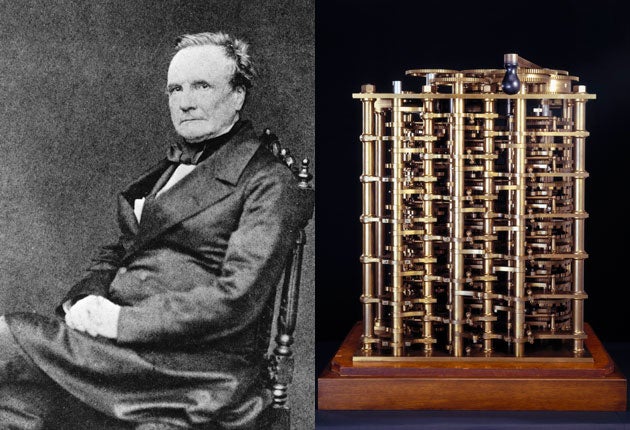
Charles Babbage (1791–1871) was an English mathematician who designed the first automatic mechanical computers, earning him the title "father of the computer".
Timeline:
Early Mechanical Era
Abacus: Invented over 4,000 years ago in Mesopotamia as an early tool for math and record-keeping.
Difference Engine: Designed by Charles Babbage in the 1820s as a steam-powered mechanical calculator.
Analytical Engine: Also conceived by Babbage in the 19th century, featuring a memory store and a processing mill.
Electronic Generations
First Generation (1940s–1950s): Used vacuum tubes. The ENIAC (1945) was the first large-scale, electronic, general-purpose computer.
Second Generation (1950s–1960s): Introduced transistors, making machines smaller, faster, and more reliable.
Third Generation (1960s–1970s): Used integrated circuits that combined many electronic parts onto a single silicon chip.
Fourth & Fifth Generation (1970s–Present): Brought microprocessors, personal computers, and artificial intelligence.
There were many evolutionary steps between the main timeline eras.
Women were instrumental in the evolution of computing. Ada Lovelace was the first modern programmer, and the computer pioneer Grace Hopper of the US Navy developed COBOL Language which is still widely used today throughout industry, predominantly in financial, manufacturing and distribution applications.
IBM, HP and others have had female CEOs/Presidents and R&D associates along the way.
Virtually all the mainframe and mini computer manufacturers (IBM, Burroughs, NCR, Honeywell, Data General, HP, etc.) adapted the COBOL language to their computer machine language structure mainly by breaking the COBOL sentences down into Assembler Language which was then compiled into machine language.
Mini and PC architecture and base languages, DOS and Windows are largely an outgrowth and evolution of UNIX architecture developed by Bell Labs.
Xerox Palo Alto Research Center ("PARC") pioneered the graphical user interface (GUI) in the 1970s, which led to the GUIs in Apple and Microsoft products.
MicroFocus of the UK was instrumental in keeping COBOL alive on mainframes/minis, and adapted it for use on PCs, adding "Windows"-like graphical user interface capability.
The key to extending the life, maintainability and sustainability of COBOL was "structured programming" whereby programs are arranged in hierarchically structured special purpose subroutines or paragraphs which are deployed by the "PERFORM" verb with its myriad of variations, virtually eliminating the often indecipherable maze resulting from use of the "GO TO" verb. With "GO TO", you don't know where you will end up until you navigate the labyrinth, if you can ... there can be many twists, turns and additional "GO TOs" along the way. With "PERFORM", you end up at the next sequential instruction. If there is a "bug" in a structured program, or a need to modify/update a program, almost any experienced programmer can quickly maintain the program because the various program functions are isolated in performed sections and paragraphs.
I have written perhaps a million or more lines of COBOL. I am also proficient in mainframe and PC assembler, and some of the newer programming languages. My focus is manufacturing, distribution and financial applications for large enterprises. I have little interest in developing apps for smartphones.
Banks, insurance companies, manufacturers and logistics/distribution industries are still inexorably intertwined with COBOL, perhaps for the remainder of the current century. AI will need to grow some hefty cojones to take over those functions. I can hardly find any use for AI in daily life. It failed miserably in attempting to create a complex program for me. Even simple programs seem to be beyond its grasp. Then, there's the seemingly impossible task of getting it to comprehend applications. I greatly prefer native Google over its AI counterpart. Google AI yields superficial results, lacking real depth. It's more like a toy ... a puppy fetching a stick and wagging its tail as if to say "look at what I did". And, the last thing I need is AI assistance with Excel.
My best hope for AI is advancement in pharmaceutical and medical research, diagnosis and treatment without leading to frankenstinian genome alteration and programming.
I may seem a bit anti-technology at times, but my philosophy of science and technology is based on the concept of the Golden Mean, with nothing in excess and nothing lacking. Advances in technology don't always add to quality of life. For the most part, what we have now may be more than what we really need for life, liberty and pursuit of happiness.
Science and Technology are not identical twins. The quest of science is discovering, knowing and predicting what was, is and will be, and why. Technology is the impetuous tyrant that doesn't give a damn about the past, is never satisfied with the present, and wants to change everything at all costs. I prefer the personality traits of science.
More info:
Pictorial History of Computers
More info
Even more info
Maybe more history of technology later, perhaps telephony and microprocessor/chip technology.
Professor Emeritus Mondo Fuego.


Message Thread  A history lesson for KR who thinks present technology is new and revolutionary. - Mondo Fuego™ September 25, 2026, 1:37 pm

« Index | View all »